How Big Is 6 Cubic Feet? Volume, Dimensions, and Uses
Learn how big is 6 cubic feet with real conversions and object comparisons. See how much space it takes up in liters, gallons, and practical uses.
You're comparing a storage container, appliance, package, or room fixture, and the specification says 6 cubic feet. The number looks precise, but it doesn't immediately tell you whether the object will fit beside a counter, inside a closet, or in the back of a vehicle. The practical question is simple: how big is 6 cubic feet in a shape you can picture?
Six cubic feet is a volume, not a single fixed set of dimensions. It can be a long, narrow box, a short and wide container, or a near-cube. Once you convert the measurement and examine a few possible shapes, the size becomes much easier to judge.
Table of Contents
- Understanding Why Visualizing Volume Is Hard
- What Cubic Feet Actually Measures
- Converting 6 Cubic Feet to Liters and Gallons
- Visualizing 6 Cubic Feet in Real Shapes
- Common Objects That Equal 6 Cubic Feet
- Using 6 Cubic Feet in Design and Storage Planning
Understanding Why Visualizing Volume Is Hard
A person ordering a storage bin might see “6 cubic feet” on the product page and still have no idea where it belongs at home. The same problem appears when someone receives a shipping estimate, chooses an appliance, or reviews a design specification. A number describes capacity accurately, but it doesn't provide a visual reference.
The difficulty comes from the fact that volume combines three dimensions at once. You aren't judging one edge, like the height of a shelf. You're judging the total interior space created by length, width, and height. A tall, narrow container and a low, broad container may hold the same amount while occupying very different parts of a room.
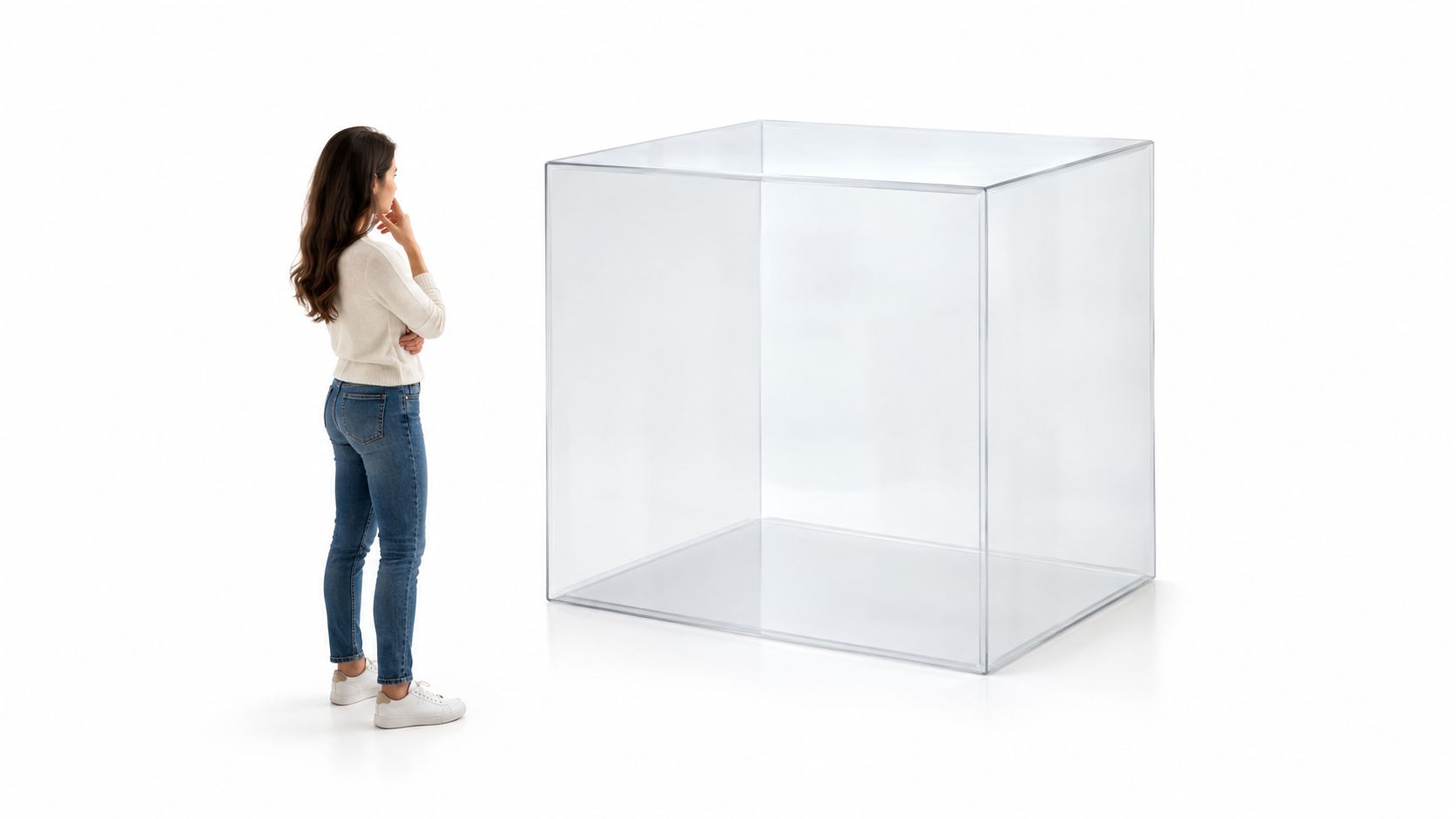
That's why a conversion alone often feels incomplete. Knowing that six cubic feet is about 170 liters is useful, especially for comparing product specifications, but it still doesn't tell you whether the container will look bulky beside a sofa or disappear beneath a workbench.
Why the surrounding space matters
Your judgment also depends on the room. A six-cubic-foot object may feel substantial in a compact utility area but modest in a garage or commercial storage room. Its footprint, height, doors, handles, and clearance can matter as much as the capacity itself.
For room planning, visual references can prevent a common mistake: focusing on the object while ignoring the space around it. Practical tips for making rooms appear larger can help when you're deciding whether a storage item or fixture will make a room feel crowded.
A simple sketch can clarify the relationship between the object and the room. If you work with plans, isometric drawing basics can also help you represent height and depth rather than relying on a flat outline.
Practical rule: Don't ask only how much a container holds. Ask how its particular length, width, and height will interact with the floor, walls, doors, and nearby furniture.
What Cubic Feet Actually Measures
A cubic foot is the volume of a cube measuring 1 foot by 1 foot by 1 foot. For a rectangular object, you calculate volume by multiplying its length, width, and height, with every measurement expressed in feet. The result describes the amount of three-dimensional space inside or occupied by the object, depending on whether you're measuring interior capacity or exterior size.
That distinction explains why “how many inches is 6 cubic feet?” isn't a valid conversion. Inches measure a single length. Square inches measure area, which combines two dimensions. Cubic feet measures volume, which combines three dimensions. You can convert six cubic feet into cubic inches, but you can't turn it into one ordinary inch measurement without choosing a specific shape.
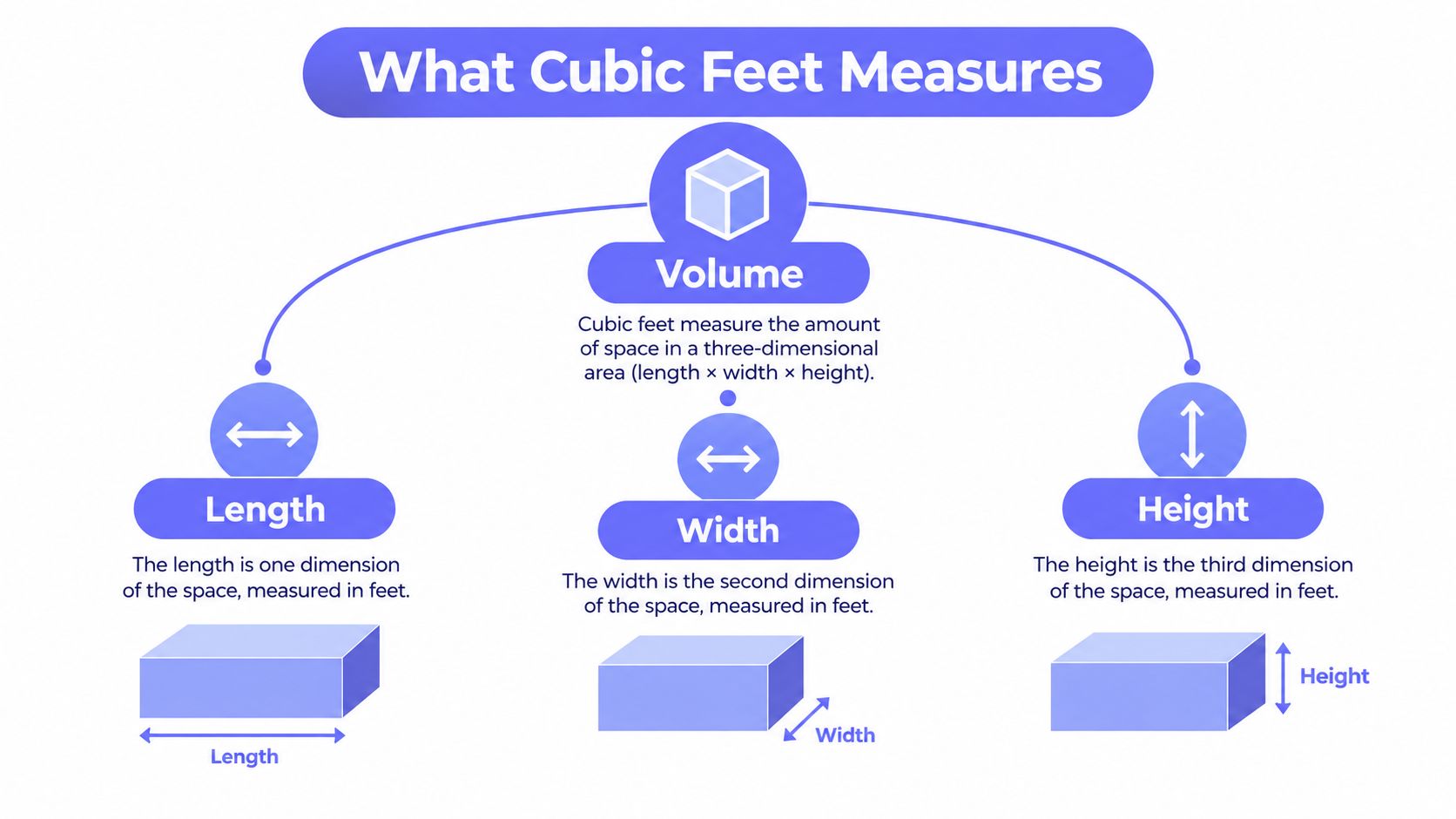
Volume, area, and length are different
Consider three questions:
- Length: How long is one edge?
- Area: How much surface does a flat floor or wall cover?
- Volume: How much three-dimensional space does an object contain?
A room renovation may require you to find square footage for home projects, but that calculation won't tell you how much a cabinet, box, or appliance can hold. Square footage helps describe a surface. Cubic footage helps describe capacity.
For six cubic feet, the dimensions can vary as long as their product equals six. One valid example is 2 feet × 1 foot × 3 feet. A different shape can have the same volume while being easier or harder to place, carry, or access.
Scale drawings create the same potential confusion. A plan drawn at a scale such as 1:50 represents dimensions proportionally, but it doesn't change the physical volume. If you're working with scaled layouts, scale drawings at 1:50 can help you interpret the drawing before judging physical space.
Converting 6 Cubic Feet to Liters and Gallons
The direct conversions are useful for product comparisons and metric planning. Using the standard conversion of 1 cubic foot = 28.316846592 liters, six cubic feet equals approximately 169.9 liters, as documented by this cubic-feet-to-liters conversion reference.
| Unit | Value |
|---|---|
| Cubic feet | 6 |
| Cubic inches | About 10,368 |
| Liters | About 169.9 |
| Cubic meters | About 0.170 |
| U.S. gallons | About 44.9 |
The liter figure is often the easiest mental shortcut. Six cubic feet is close to the space occupied by 170 one-liter bottles, although a real container won't necessarily fit that many bottles because bottle shapes, gaps, walls, shelves, and access openings reduce usable capacity.
The gallon comparison gives another everyday reference. Six cubic feet is close to 44.9 U.S. gallons, but this doesn't mean the object must look like a large cylindrical tank. A rectangular cabinet, chest, or appliance can hold the same volume while having a completely different footprint.
How to calculate the volume yourself
For a rectangular object, use this formula:
Length × width × height = cubic feet
Measure each dimension in feet. If an object is 2 feet long, 1 foot wide, and 3 feet high, multiply 2 × 1 × 3 to get six cubic feet. If your measurements are in inches, convert them to feet first, or calculate in cubic inches and convert the result afterward.
The dimensions determine the shape, while the multiplication determines the capacity. A square-meter calculator can help with related area work, but area and volume should remain separate in your notes and specifications.
Visualizing 6 Cubic Feet in Real Shapes
Six cubic feet doesn't describe one standard box. It describes a total amount of space that can be arranged in several ways. A long container may fit beneath a bench, while a taller version may work better as a narrow cabinet. Both can hold the same volume if their dimensions multiply to six.
Start with a straightforward example:
2 feet × 1 foot × 3 feet = 6 cubic feet
This shape is narrow and tall. It could resemble a slim storage cabinet or an upright container, depending on its walls and opening. Its capacity is substantial, but its footprint is relatively restrained.
A second example is:
1.5 feet × 2 feet × 2 feet = 6 cubic feet
This version is shorter and more compact. Compared with the first shape, it spreads the same volume across a broader base and lower height. That difference may affect whether it fits under a counter, beside a cabinet, or within a shelving bay.
Shape changes usability
A third arrangement can be approximately 1.5 feet × 1.5 feet × 2.67 feet, which is also close to six cubic feet. It is taller than it is wide, but not as elongated as the 2-by-1-by-3-foot example.
The volume stays the same, yet the practical experience changes:
- Long and low: Easier to slide beneath some surfaces, but it may require more floor length.
- Tall and narrow: Uses less floor area, but it may need overhead clearance and stable placement.
- Short and broad: Often easier to access from above, though it can occupy more width.
When you place these shapes into a floor plan, the outline alone isn't enough. You need height to understand the visual effect and clearance to understand whether doors, walkways, or furniture will remain usable. For a quick way to turn a plan into a spatial view, ISO Mapper can create a three-dimensional isometric representation from a floor plan.
A useful test: Draw the object in its actual length, width, and height, then compare its footprint and top clearance separately. Capacity tells you what fits inside. Dimensions tell you where it fits.
Common Objects That Equal 6 Cubic Feet
Everyday comparisons make the measurement easier to retain, but they should be treated as approximations. A product's stated capacity may describe its interior volume, while the outside dimensions include insulation, walls, hinges, controls, shelves, and other components.
A small refrigerator or compact freezer can provide a useful reference point because appliance specifications commonly use cubic feet to describe interior capacity. A unit around six cubic feet feels more substantial than a countertop box, but it isn't automatically tall or wide. Shelves and compartments also mean that the usable arrangement differs from an empty rectangular container.
A large storage tote offers another close mental model. Unlike an appliance, a tote may have tapered sides, a thick rim, or a lid that reduces the opening. Its stated capacity can be close to six cubic feet while its usable packing space feels smaller because irregular objects leave gaps.
Side-by-side practical comparisons
| Example | What the comparison helps you judge |
|---|---|
| Small refrigerator or freezer | Interior capacity, shelving, door swing, and vertical clearance |
| Large storage container | Packing volume, lid clearance, and portability |
| Microwave-sized appliance grouping | The difference between one object and an equivalent combined volume |
| Compact furniture compartment | How drawers, doors, and framing reduce usable interior space |
| Design or shipping box | Whether a long, narrow or short, broad shape suits the route and destination |
A microwave oven by itself may not have six cubic feet of interior space, but several microwave-sized volumes can help you understand the total. This comparison is useful because many people recognize the physical scale of a countertop appliance more readily than they recognize a cubic measurement.
Compact furniture gives the most important caution. A bench, cabinet, ottoman, or sideboard may enclose roughly six cubic feet, but legs, dividers, drawer hardware, and framing consume space. The exterior can also feel much larger than the internal capacity. If you're planning a room, guidance on furniture placement in a living room can help you evaluate circulation and visual balance alongside raw volume.
The best comparison depends on what you need to store. Soft goods can conform to a container. Rigid objects need usable opening dimensions, not just total capacity. A six-cubic-foot box may hold a large quantity of flexible items but reject one bulky object that cannot pass through its door.
Using 6 Cubic Feet in Design and Storage Planning
Designers and homeowners can use six cubic feet as a planning checkpoint. First, calculate the required volume. Then choose dimensions that suit the room, access path, opening size, and storage method. Finally, verify the physical footprint and height separately, because a correct capacity can still produce an impractical object.
For packaging, multiply the proposed length, width, and height, then compare the result with six cubic feet. For cabinetry, subtract the space occupied by walls, shelves, doors, and hardware before estimating usable storage. For room layouts, check door swings, walking routes, and maintenance access rather than placing a volume as an isolated block.
If you're selecting a storage facility, a guide to choosing a storage unit size can provide useful context for matching possessions to available space. The same principle applies at home: list the objects, estimate their packing arrangement, and leave room for access instead of treating every inch as usable.
A reliable takeaway is this: six cubic feet equals about 169.9 liters, but its real-world size depends on its shape. Use the conversion for capacity, the dimensions for fit, and a three-dimensional sketch for communication.
Vizcraft helps designers turn floor plans into client-ready 3D isometric views and room visuals, making proportions, furniture placement, and spatial relationships easier to review. Visit Vizcraft to try it with 2 free credits, no card required.